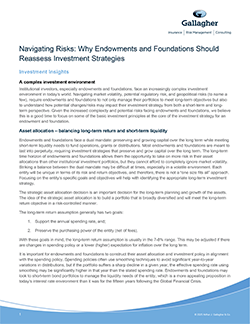
Navigating Risks: Why Endowments and Foundations Should Reassess Investment Strategies
Endowments and foundations face a dual mandate: preserving and growing capital over the long term while meeting short-term liquidity needs to fund operations, grants or distributions. This is increasingly challenging in today’s complex investment environment. Most endowments and foundations are meant to last into perpetuity, requiring investment strategies that preserve and grow capital over the long term. This long-term time horizon allows them the opportunity to take on more risk in their asset allocations than other institutional investment portfolios, but they cannot afford to completely ignore market volatility. Striking a balance between the dual mandate may be difficult at times, especially in a volatile environment.
Navigating market volatility, potential regulatory risk, and geopolitical risks require endowments and foundations to not only manage their portfolios to meet long-term objectives but also to understand how potential changes/risks may impact their investment strategy from both a short-term and long-term perspective. From a market perspective, understanding your risk exposure and stress testing your portfolio is very important in the overall decision-making process. Stress testing the portfolio may provide key decision makers with insight into how bad a situation can potentially be based on certain market conditions. One part of the stress testing is to analyze the liquidity under different market conditions. It is important to understand how liquid your portfolio is and how easily you can meet your liquidity needs if unforeseen market events occur. Now is a good time to focus on the basic investment principles at the core of the investment strategy for an endowment and foundation.
This whitepaper provides a guide for Healthcare CEOs and Boards on balancing liquidity and growth.
For Institutional Use Only. Not for Public Distribution.
This material was created to provide information on the subjects covered, but should not be regarded as a complete analysis of these subjects. The information provided cannot take into account all the various factors that may affect your particular situation. The services of an appropriate professional should be sought regarding before acting upon any information or recommendation contained herein to discuss the suitability of the information/recommendation for your specific situation.
Investment advisory services are offered by Gallagher Fiduciary Advisors, LLC (“GFA”), an SEC registered investment advisor that provides retirement, investment advisory, discretionary and independent fiduciary services. Registration as an investment adviser does not imply any specific level of skill or training and does not constitute an endorsement of the firm by the SEC. GFA is a limited liability company with Gallagher Benefit Services, Inc. as its single member. GFA may pay referral fees or other remuneration to employees of Arthur J. Gallagher & Co. or its affiliates or to independent contractors; such payments do not change our fee. Neither Arthur J. Gallagher & Co., GFA, their affiliates nor representatives provide accounting, legal or tax advice. GFA/Osaic CD (8138196)(exp072027)
This content is for informational purposes only and is not a recommendation for any specific investment product, strategy, plan feature or other purposes. The opinions and information contained herein should not be construed as Legal or Tax advice. All information that is obtained from external sources cannot be guaranteed but is provided by those who have been proven to be credible, reliable, and recognizable.
Download Your Complimentary Copy
By downloading this resource, I agree to sign up to receive newsletters and special offers from HealthLeaders and the sponsor. I understand that I can opt out at any time. Privacy policy.